
VEX IQ COURSES
Build. Code. Explore. Compete.

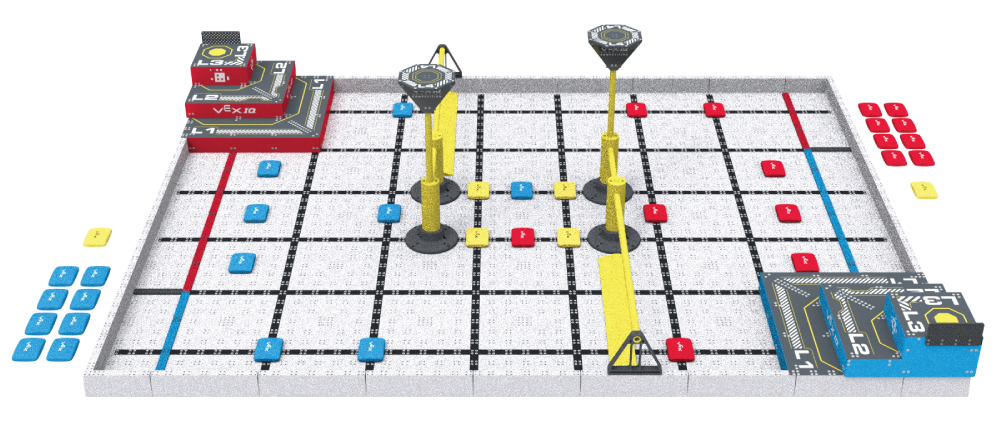
What are VEX IQ Courses?
The VEX IQ Courses track is where every Robo Hub robotics journey begins. Through three project-based courses: Fundamental, Advanced, and Competition Bootcamp, students go from building their first robot to designing competition-ready machines, one hands-on project at a time.
No experience is needed to start. Each project introduces new engineering, programming, and problem-solving skills through a fun challenge to complete, and every course ends with students ready for the next step.
Your Pathway
1. Fundamental
Start here: build and code your first robots through hands-on projects. No experience needed.
2. Advanced
Design real mechanisms: gearboxes, intakes, lifts, and learn to pick the right one for the job.
3. Competition Bootcamp
Train like a team: game strategy, competition robots, autonomous programming, and mock matches.
4. Competition
Join a VEX IQ Competition team and compete through the full season, up to the World Championship.
New students start at Fundamental or join Competition Bootcamp directly; experienced students may test directly into a Competition team.
Fundamental
Build. Code. Explore. Compete.
Students learn the fundamentals of robotics through a series of hands-on projects using the VEX IQ system. Each project introduces new engineering, programming, and problem-solving skills while giving students a fun challenge to complete.
1
Robot Racer
4 Lessons
Build your first VEX IQ BaseBot and learn how motors, wheels, axles, and structural components work together. Students practice driving with the controller and improve their robot for speed, stability, and accuracy.
2
Robot Soccer
4 Lessons
Design and build a simple manipulator that lets the robot control, move, and score game objects. Students explore basic mechanism design while developing driving skills through a fast-paced robot soccer challenge.
3
Tug of War
4 Lessons
Discover how wheel choice, traction, weight distribution, gear ratio, and center of mass affect robot performance. Students modify their BaseBot and compete to build the strongest pulling robot.
4
Claw Challenge
5 Lessons
Transform the BaseBot into a functional Clawbot that picks up, carries, and releases objects. Students learn about robot arms, gears, lifting mechanisms, motor control, and mechanical advantage.
5
Cube Collector
5 Lessons
Learn the difference between driver-controlled and autonomous robotics. Students program their Clawbot to collect, transport, and organize cubes while learning sequencing, motor commands, loops, and basic autonomous movement.
6
Treasure Hunter
5 Lessons
Add sensors so the robot reacts to its environment. Students use the Optical Sensor and Distance Sensor to detect objects, identify colors, and program the robot to search for and collect specific game pieces.
7
Smart Robot Challenge
5 Lessons
Combine building, driving, sensors, and programming in a final engineering challenge. Students design their own strategy, improve their robot through testing, and compete in a mini robotics game that introduces the teamwork and problem-solving style of VEX IQ competitions.
Mechanical Design • Robot Building • VEXcode Programming • Sensors • Driver Control • Engineering Design • Teamwork • Problem Solving
Advanced
Design. Build. Optimize.
VEX IQ Advanced takes students beyond basic robot building and introduces the mechanical systems commonly used in high-performance and competition robots. Through hands-on engineering projects, students explore advanced drivetrains, power transmission, intake systems, and lifting mechanisms, learning not only how mechanisms are built, but how to select the right mechanism for a specific robotics challenge.
1
Gearbox Challenge
4 Lessons
Explore how gear ratios change a robot’s speed and torque. Students build and compare multiple gear combinations, including compound gear systems, and learn how engineers balance speed, power, efficiency, and motor load.
Topics: Gear Ratio • Compound Gears • Speed vs. Torque • Gear Trains • Idler Gears
2
Speed Machine
4 Lessons
Upgrade a standard drivetrain with advanced power-transfer systems. Students experiment with gears, chain and sprockets, wheel configurations, and drivetrain ratios, then build and test their own high-performance drivetrain.
Topics: Chain & Sprocket • Gear-Based Drivetrain • Wheel Selection • Power Transfer • Drivetrain Ratios
3
Power Intake
5 Lessons
Design a mechanism that quickly collects, controls, and transports multiple game objects. Students explore roller intakes, conveyor systems, friction, compression, and continuous object movement, then optimize their intake for speed and reliability.
Topics: Roller Intake • Conveyor • Chain Drive • Friction • Object Retention • Continuous Motion
4
Linear Motion
4 Lessons
Learn how a motor’s rotational motion becomes controlled linear movement. Students experiment with rack-and-pinion systems and linear sliders before designing a mechanism that extends, pushes, or positions objects.
Topics: Rack & Pinion • Linear Slider • Rotary-to-Linear Motion • Mechanical Alignment
5
4-Bar Lift
5 Lessons
Build a lifting system that raises game objects while keeping the end mechanism stable. Students investigate 4-bar linkages, gear reduction, torque, center of gravity, and structural reinforcement.
Topics: 4-Bar Linkage • Parallel Lift • Gear Reduction • Torque • Structural Support
6
High Reach
5 Lessons
Take lifting mechanisms further with chain-bar arms, 6-bar lifts, and reverse 4-bar systems. Students compare lifting architectures, learn when each design wins, and build a compact mechanism that reaches far beyond a standard robot arm.
Topics: Chain-Bar • 6-Bar Lift • Reverse 4-Bar • Gear Synchronization • Center of Gravity
7
Robot Designer
5 Lessons
Combine multiple advanced mechanisms into one complete robot. Given a competition-style challenge, teams choose a drivetrain, intake, lifting mechanism, and manipulator, then follow the full engineering design process: research, brainstorm, prototype, test, and iterate.
Topics: Subsystem Integration • Strategy-Based Design • Mechanism Selection • Testing • Optimization • Iterative Engineering
Gear Systems • Drivetrain Design • Chain & Sprockets • Intake Systems • Conveyors • Linear Motion • Linkages • Lifting Systems • Robot Optimization • Competition Engineering
Competition Bootcamp
Prepare. Practice. Compete.
VEX IQ Competition Bootcamp is for students who already have VEX IQ building and programming experience and are preparing to join a competition team. Through six competition-focused projects, students learn to analyze a game, develop strategy, design and improve a competition robot, program autonomous routines, practice driving skills, document the engineering process, and experience realistic match simulations.
1
Game Analysis & Strategy
4 Lessons
Learn to read a VEX IQ game manual: scoring opportunities, penalties, and field analysis. Students compare scoring strategies and start thinking about how robot design should support the team’s overall game plan.
Topics: Game Rules • Scoring • Penalties • Field Analysis • Match Strategy • Strategic Thinking
2
Hero Robot & Concept Design
5 Lessons
Build and test a Hero Robot to understand the current game and its common scoring mechanisms. Students evaluate strengths and weaknesses, research alternatives, brainstorm ideas, and develop their own competition robot concept.
Topics: Hero Robot • Robot Analysis • Brainstorming • Mechanism Selection • Design Sketching • Strategy-Based Design
3
Competition Robot Development
6 Lessons
Build and improve a complete competition-style robot with drivetrain, intake, lifting, and manipulation systems. The focus: reliability, simplicity, weight distribution, structural strength, and ease of repair.
Topics: Drivetrain • Intake • Manipulator • Lifting Mechanisms • Subsystem Integration • Reliability • Iterative Design
4
Autonomous & Sensor Programming
5 Lessons
Program the robot to score without driver control. Students build autonomous consistency through precise movement, motor feedback, sensors, repeatable starting positions, and systematic debugging.
Topics: Autonomous Programming • Sensors • Motor Position • Loops • Conditions • Debugging • Repeatability
5
Driver Skills & Robot Optimization
5 Lessons
Develop competition-level driving through timed drills and repeated scoring practice: faster cycles, accurate positioning, efficient routes, mistake recovery, and smooth driver teamwork.
Topics: Driver Control • Scoring Cycles • Route Planning • Speed • Accuracy • Robot Tuning • Skills Practice
6
Competition Readiness Challenge
5 Lessons
Rehearse a real competition: engineering notebook practice, judge interviews, team-role training, robot inspection, Skills runs, and full match simulations, ending with a mock competition.
Topics: Engineering Notebook • Judge Interview • Team Roles • Robot Inspection • Driving Skills • Autonomous Skills • Match Simulation
Game Strategy • Competition Robot Design • Autonomous Programming • Driver Skills • Engineering Notebook • Judge Interview • Teamwork • Robot Optimization • Match Preparation
Ready for Competition?
Finished Competition Bootcamp, or already have VEX IQ experience? Take the next step and join a VEX IQ Competition team: train through the season and compete from local qualifiers all the way to the World Championship.